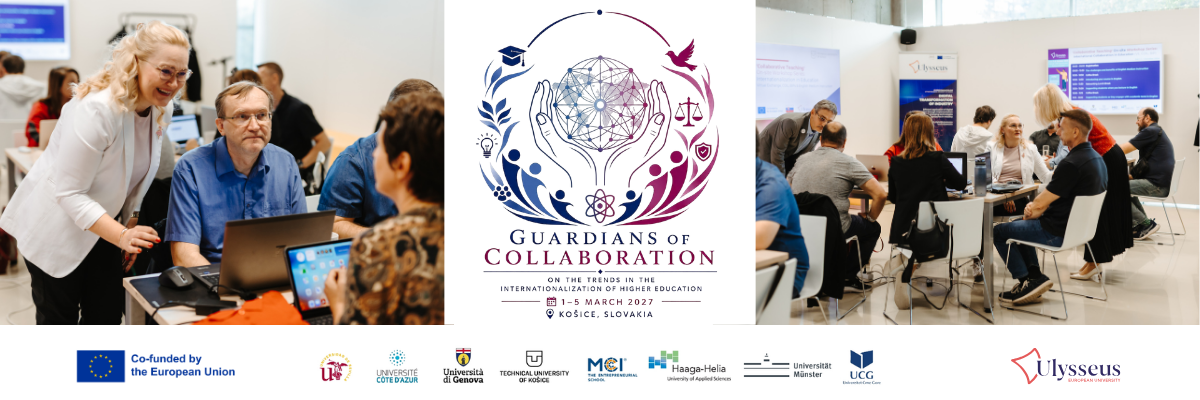
How can higher education institutions rethink their internationalisation strategies to remain relevant, competitive and resilient in a rapidly changing global environment – while creating value not only for their own institutions but also for the local, regional and international ecosystems in which they operate?
This five-day Blended Intensive Programme is designed for university leaders and senior professionals responsible for internationalisation and institutional development at the central level. It offers a strategic platform for exploring emerging global trends, strengthening institutional approaches to international engagement, attracting and retaining global talent, and navigating the challenges of international research and cooperation.
A key focus of the programme is exploring how universities can leverage internationalisation as a driver of broader development and impact: connecting global talent, knowledge, research and partnerships with local and regional needs, strengthening innovation ecosystems, fostering collaboration with businesses, public authorities and other stakeholders, and creating mutual benefits for international partners and communities.
Through expert insights, international peer exchange, case studies and strategic discussions, participants will explore how to position internationalisation as a key driver of institutional transformation, innovation and sustainable development – moving beyond the traditional boundaries of the university towards a more interconnected and mutually beneficial ecosystem.
Please be aware that your home university may set a different application deadline depending on their internal selection process.
Course Outline
This five-day Blended Intensive Programme offers a strategic and forward-looking exploration of the evolving role of internationalisation in higher education. It is designed for university leaders and senior professionals responsible for shaping and implementing institutional internationalisation strategies, including vice-rectors, pro-rectors, heads and deputy heads of International Relations Offices, and senior representatives responsible for research, knowledge transfer, external relations and international partnerships.
Through expert-led sessions, institutional case studies, strategic discussions and collaborative activities, participants will exchange experiences, compare institutional approaches and address common challenges in international higher education. Particular emphasis will be placed on peer learning, international cooperation and exploring how universities can leverage internationalisation to strengthen their institutional development while generating value for local, regional and international ecosystems.
As a concluding activity, participants will collaboratively develop strategic recommendations and identify priority actions to advance internationalisation within their respective institutions.
Course Content
- Global trends and emerging paradigms in higher education internationalisation
- Strategic internationalisation and its contribution to institutional development, positioning and competitiveness
- Global perspectives on internationalisation beyond the European higher education context
- Internationalisation strategies, institutional leadership and strategic governance
- Attracting, retaining and managing global academic talent
- Building inclusive and internationally attractive university environments
- Reciprocal international mobility and balanced global partnerships
- Geopolitical developments and their implications for international higher education cooperation
- Responsible international partnerships, research security, trust and institutional risk management
- International research and innovation cooperation
- Knowledge transfer and the role of internationalisation in strengthening innovation ecosystems
- Connecting international engagement with regional development and societal impact
- Digital internationalisation and the future of international engagement beyond physical mobility
- Strategic priorities and institutional responses for the universities of tomorrow.
Learning Outcomes
Following this course, participants will be able to:
- Critically assess emerging global trends, geopolitical developments and changing higher education landscapes, and their implications for institutional internationalisation strategies
- Identify and formulate strategic priorities and approaches for strengthening institutional internationalisation policies, governance and practices in response to evolving global challenges
- Develop strategic approaches to attracting, engaging and retaining international talent, fostering institutional attractiveness, inclusion and a sense of belonging
- Assess and strengthen international partnerships and cooperation frameworks, taking into account strategic value, reciprocity, trust, institutional interests and responsible engagement
- Evaluate and navigate the opportunities and risks of international research and innovation cooperation, including geopolitical developments, research security and institutional resilience
- Identify opportunities to leverage internationalisation for the benefit of wider ecosystems by connecting global talent, knowledge and partnerships with research, knowledge transfer, innovation, local and regional development, and societal needs
- Explore and assess emerging models of international engagement beyond traditional mobility, including digital internationalisation and new forms of global collaboration
- Exchange and critically benchmark institutional strategies, governance approaches and good practices with international peers, identifying opportunities for institutional learning and improvement
- Translate strategic insights into action by formulating recommendations and identifying priorities for advancing internationalisation within their respective institutions.
Requirements
Target Group and Eligibility
This BIP is intended for higher education institution staff involved in the strategic planning, coordination, management or implementation of internationalisation and related institutional processes at the central level.
The programme is particularly suitable for:
- Vice-Presidents/Vice-Rectors for internationalisation, research, knowledge transfer, external relations or institutional development
- Heads and Deputy Heads of International Relations Offices (IROs)
- Directors and senior managers responsible for international partnerships, global engagement and internationalisation strategies
- Senior professionals involved in international research cooperation, institutional development and strategic university partnerships.
Professional Background
Applicants should be employed by a higher education institution and hold a position relevant to the programme's themes. Professional experience in higher education management, international relations, international cooperation or institutional internationalisation is expected.
Language Requirements
Participants are expected to have a good command of English (minimum B2 level according to the Common European Framework of Reference for Languages – CEFR), as all sessions, discussions and collaborative activities will be conducted in English. They should be able to actively contribute to professional discussions, exchange institutional experiences and participate in collaborative activities in English.
Virtual Component
Practical Details Regarding the Virtual Component:
The virtual component will consist of two online sessions complemented by individual preparation and networking through a dedicated Microsoft Teams space. The aim is to introduce the main themes of the BIP, facilitate initial connections among participants and encourage them to reflect on their institutional experiences and priorities ahead of the face-to-face programme.
Virtual activities:
- Session 1 – Internationalisation at a Turning Point: Introduction to the changing global higher education landscape, emerging trends and key challenges shaping institutional internationalisation strategies.
- Session 2 – Connecting Perspectives: Participant introductions, exchange of institutional experiences and initial reflection on shared challenges and priorities in internationalisation.
- Individual Preparation: Participants will be invited to identify key internationalisation priorities and challenges within their own institutions to bring into the discussions during the physical programme.
Dedicated Microsoft Teams Space:
A dedicated MS Teams space will be established to facilitate communication, networking and information exchange before, during and after the BIP. It will serve as a shared platform for participant introductions, preparatory materials, initial discussions and continued exchange of experiences and good practices.
Physical Mobility
📅 Day 1 (Monday)
📍 Venue: University Science Park TECHNICOM, Němcovej 5, 040 01 Košice, SlovakiaMorning:
- Opening & Welcome
Afteroon:
📅 Day 2 (Tuesday)
📍 Venue: University Science Park TECHNICOM, Němcovej 5, 040 01 Košice, SlovakiaMorning
Afternoon
📅 Day 3 (Wednesday)
📍Venue: University Science Park TECHNICOM, Němcovej 5, 040 01 Košice, SlovakiaMorning
Afternoon
📅 Day 4 (Thursday)
📍Venue: University Science Park TECHNICOM, Němcovej 5, 040 01 Košice, SlovakiaMorning
Afternoon
- From Campus to Ecosystem: Moving Beyond Institutional Boundaries
📅 Day 5 (Friday)
📍Venue: University Science Park TECHNICOM, Němcovej 5, 040 01 Košice, Slovakia
Application Process
Application procedure
Interested staff members should express their interest through their respective sending universities. Each partner university is responsible for disseminating the BIP call, organising its internal selection procedure and nominating participants. The selection should prioritise candidates whose professional responsibilities are directly related to the strategic planning, coordination and implementation of internationalisation and institutional development.
Required application documents
Applicants are required to complete the application form, providing information about their current position, professional experience and areas of interest.
Application deadline
Final nominations from the sending institutions should be communicated to the Technical University of Košice 8 January 2027 to the email address: natalia.vaskova@tuke.sk
 |
 |